Clinical power and professional responsibility.
Scrutinize discriminatory treatment, reproductive coercion, professional enforcement and the adequacy of public advocacy. Medical expertise creates the capacity to identify harm and demand prevention.
Look beneath the national average.
Ten minutes, eight parts, four voices. Or read the transcript.
Regional series use different populations and methods. Compare matched groups within each panel; do not treat these as a province ranking.
Published life-expectancy estimates · Canada
11-year gap in the published estimates.
The same country. Profoundly different outcomes.
Source: Statistics Canada [1]. Linked census cohorts representing private households. Read the methods.
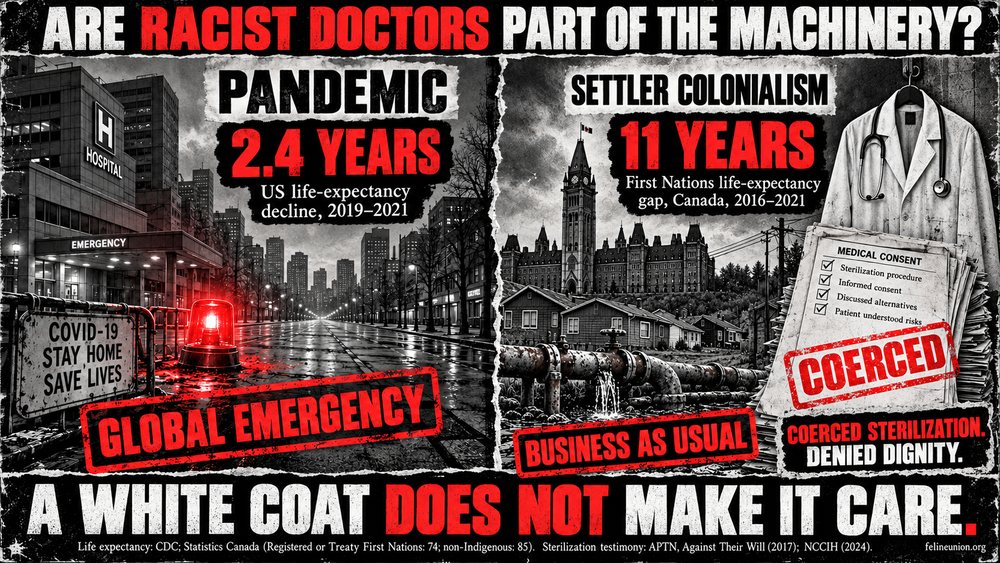
Use the pandemic as a reference point. Compare the size of the life-expectancy differences.
Registered or Treaty First Nations / non-Indigenous life expectancy in the same Canadian study.
11 ÷ 2.4, an arithmetic comparison of two different measures. Not a mortality-risk or trauma multiplier.
A change over time and a difference between populations are distinct comparisons. The US decline includes causes beyond COVID-19. The Canadian figures represent linked census cohorts from private households, with methodological limitations. Life expectancy describes survival under the mortality conditions of the measured period; it is not a prediction that every person loses exactly eleven years.
Institutions administer individual mandates. People experience their consequences together. Select a pressure to explore an analytical pathway. These pathways are not estimates of how much each factor contributes to the gap.
This is the structural-violence argument: imposed, preventable conditions can damage health and autonomy through ordinary administration. The diagram explains possible pathways. It does not assign a measured share of the eleven-year gap to each one.
Accountability must examine what institutions are designed to do, as well as whether their members obey the rules.
People misuse entrusted power, conceal wrongdoing or breach protective standards. Investigate the conduct, identify responsibility and enforce consequences.
The authorized objective, funding arrangement or service rule itself produces harm. Examine the mandate, change the policy and transfer decision-making power where required.
The Truth and Reconciliation Commission described a sustained government policy aimed at dismantling Indigenous governments, disregarding rights, ending treaties and assimilating Indigenous peoples out of existence as distinct societies. It identified residential schools as a central instrument of that policy and characterized it as cultural genocide.
The harm was organized through institutions entrusted with authority.
TRC, Honouring the Truth, Reconciling for the Future, summary of the final report, introduction, 2015. Hosted by the National Centre for Truth and Reconciliation.
Read the TRC report ↗| Examine conduct | Examine the arrangement |
|---|---|
| Was consent obtained without coercion? | Who designed the consent process, and can patients exercise a meaningful choice? |
| Was a patient denied appropriate treatment? | Do eligibility, staffing or funding decisions make access unequal? |
| Was a complaint investigated properly? | Can the remedy stop harm in time, and who controls the review? |
| Were professional standards followed? | Do those standards deliver protection that affected Nations can independently assess? |
These are the site's analytical tests for present institutions. The TRC finding establishes the historical policy described above; present policies must be assessed through their own records and outcomes.
Governments change. Institutions can retain expertise and authority across political terms, although records can be lost or destroyed. Shared responsibility does not mean nobody is responsible.
Scrutinize discriminatory treatment, reproductive coercion, professional enforcement and the adequacy of public advocacy. Medical expertise creates the capacity to identify harm and demand prevention.
Assess whether remedies stop harm, whether orders are implemented, and whether people can obtain protection without years of litigation. A later remedy cannot undo harm already suffered.
Trace funding, service rules, infrastructure and enforcement. Compare what authorities knew with what they changed, and what persisted after explicit notice.
The Truth and Reconciliation Commission's health Calls to Action provide an existing record against which institutional responses can be examined.
The TRC calls on governments to acknowledge the connection between Indigenous health and previous government policies, including residential schools, and to implement Indigenous healthcare rights.
It calls on the federal government, in consultation with Indigenous peoples, to set measurable goals for closing health gaps, publish annual progress reports and assess long-term trends. Life expectancy is one specified indicator.
Call 23 addresses Indigenous health professionals, retention and cultural competency training. Call 24 addresses required medical and nursing education, including human rights and anti-racism.
These are summaries of the TRC's recommendations. This page documents evidence and institutional responses; it does not issue a new set of demands or certify implementation.
Published in 2015. Health is addressed in Calls 18–24.
Read the TRC's full text at the NCTR ↗Survivors' testimony entered the institutional record. Follow the decisions that came after it.
Indigenous women described being pressured into sterilization in Saskatoon healthcare. Their testimony prompted internal and external reviews.
The warning came from the people harmed.
Public disclosures: 2015. NCCIH synthesis, provincial response, p. 5 ↗
The revised policy required prenatal discussion and documentation before postpartum tubal ligation. The response shows that the institution had received notice and could change its rules.
Notice was followed by an institutional decision.
Policy revision: 2016. Boyer and Bartlett external review, background and policy analysis ↗
Boyer and Bartlett documented coercion, loss of trust and women feeling powerless. The review set out ten Calls to Action. NCCIH also identifies weaknesses in the policy response: limited consultation, inadequate accompanying training and barriers for people without a regular family physician.
Changing a rule did not settle the underlying failures.
External review: 2017. Commissioned by the Saskatoon Health Region and conducted by Métis reviewers with community participation. Read the review ↗ · NCCIH analysis of the policy limitations ↗
The health region apologized. Women also pursued a civil lawsuit alleging sterilization without proper consent. APTN reported survivors seeking compensation and redress through the courts.
Survivors still had to pursue accountability.
Apology and lawsuit reporting: 2017. APTN reporting and survivor account ↗. This entry records the filing and public response, not the current disposition of the litigation.
The Saskatchewan Health Authority identifies its Indigenous Birth Support Worker program in Saskatoon as part of the response to the tubal-ligation report. Its stated purpose is culturally responsive support during labour, birth and postpartum care.
A documented intervention. Its existence is not proof that coercion ended.
SHA description of the program and its origins ↗. This is the institution’s account of its own response, not an independent finding of system-wide safety.
The sources assembled here do not establish that coercion was eliminated or that every survivor obtained a remedy. The next measure is independent, survivor-informed evidence of consent, protection and redress.
This sequence establishes notice and responses by the Saskatoon Health Region and Saskatchewan Health Authority. The professional-body record below adds parliamentary testimony and identifies the evidence still needed for each institution.
A documented response shows what an institution did. Demonstrated protection requires evidence of results for patients.
| Institution | Documented response | Outcome still unverified here |
|---|---|---|
| CMA ↗ | Legislative advocacy and acknowledgment of the profession's role. | Patient protection resulting from that advocacy. |
| CPSS ↗ | Consent policy and acknowledgment of a federal letter. | Case-specific investigation, discipline or survivor remedy. |
| SMA ↗ | Joint racism survey, anti-racism resources and reconciliation commitment. | Sterilization-specific action and its results for survivors. |
This compares the evidence assembled here. An unverified outcome is not a finding that no action occurred. Select an institution to open its sources.
The CMA supported legislation addressing sterilization without consent. Its president acknowledged the profession's role and described the harm as rooted in systemic racism.
Senate testimony, September 25, 2025. The CMA also described its support for the predecessor bill. This establishes a public position and legislative advocacy, not verified patient outcomes.
Read the Senate transcript ↗Survivors' lawyer Alisa Lombard told Parliament that her client D.D.S. was sterilized without proper consent after the Saskatchewan regulator and other institutions had specific knowledge of the practice.
The College's published consent policy requires a voluntary, informed choice and recognizes the right to withdraw consent.
House of Commons testimony, June 13, 2019, concerning a procedure in December 2018. This is counsel's testimony on behalf of survivors, not a court finding against CPSS.
Read the survivor counsel's testimony ↗
The current consent policy lists original approval in June 2011 and amendment in June 2022. Section 3 requires decisions free of coercion. The document does not identify the amendment as a response to this case.
On January 11, 2019, The Canadian Press reported that CPSS acknowledged receiving a federal letter and called further comment premature. This is a reported public response, not a disciplinary decision.
Read the contemporaneous report ↗
A case-specific investigation, disciplinary outcome or survivor remedy has not been verified here. The public discipline page uses broad conduct labels and paginated records. The accessible entries cannot establish whether this case was investigated.
Public discipline records ↗The SMA documents a joint racism survey with CPSS, an anti-racism guide and a truth-and-reconciliation commitment. These establish broader professional work.
A sterilization-specific SMA response and its results for survivors remain unverified.
The SMA's EDI page describes a fall 2023 survey of racism within the medical profession. Its EDI complaint route serves physicians, residents and medical students; it excludes complaints from the public. This is a member-support route, distinct from CPSS's patient complaints process.
Read the SMA's documented EDI work ↗
The association announced reconciliation artwork on October 9, 2026. Its linked reconciliation page describes further work as developing. This establishes a stated commitment, not a sterilization-specific policy or measured patient outcome.
Read the reconciliation commitment ↗
Review included these pages, the public publications and Digest indexes, and indexed searches for forced or coerced sterilization and tubal ligation. Complete historical issues, member-only records and assembly minutes were not examined. Missing results do not prove inaction.
Association remit ↗The Native Women's Association of Canada called for Indigenous-led accountability and monitoring. The Senate recommended stronger discipline, consent protections and complaint investigations.
The Senate Human Rights Committee called for stronger medical-college disciplinary processes, clear consent standards and mechanisms to investigate and respond to complaints. It also recommended training in bodily autonomy and medical self-determination as a condition of professional licensing.
The Scars that We Carry: Forced and Coerced Sterilization of Persons in Canada, Part II, July 2022, recommendations 2 and 5. These are the committee's recommendations, not a new campaign platform or a finding about a particular Saskatchewan disciplinary case. Their implementation has not been comprehensively verified here.
Read the Senate recommendations ↗Asked how prevention efforts were being evaluated, Indigenous Services Canada official Laura Mitchell told senators that the requested effectiveness data were not yet available. She also described engagement with regulatory bodies as limited.
The National Council of Indigenous Midwives testified that voluntary anti-racism initiatives alone could not end forced sterilization. Its witnesses emphasized Indigenous-led prevention and said patients should not bear responsibility for protecting themselves while seeking care.
Senate Legal and Constitutional Affairs Committee, March 20, 2024, study of Bill S-250. These statements describe the evidence and programs discussed at that hearing. They do not establish current outcomes or a CPSS disciplinary finding.
Read the exchanges with Senator Pate and the Indigenous midwives ↗The Native Women's Association of Canada called for Indigenous-led accountability mechanisms, regulatory cooperation and annual reporting to identify troubling sterilization trends and trigger investigations.
Francyne Joe, NWAC president, House of Commons testimony, June 13, 2019.
Read NWAC's recommendations ↗Bill S-228 received Royal Assent on June 15, 2026. The amendment clarifies that a sterilization procedure wounds or maims for the purposes of the Criminal Code's aggravated-assault provision. Legislative change is a documented response; enforcement and remedies must be evaluated separately.
Read the enacted amendment ↗First Nations should be able to describe their own conditions, through their own institutions, on their own terms. Provincial boundaries should not decide whose experience becomes visible.
The political question extends beyond whether a figure is accurate. Who chooses the population, controls the records, sets the questions and decides when the findings are released?
The First Nations Information Governance Centre explains OCAP® through four principles. Each Nation applies them in accordance with its own worldview and protocols.
A Nation's collective relationship to information about its people.
Authority over research and information processes, from the questions to the use of findings.
Access to information about the Nation wherever it is held, and authority over access to collective information.
Physical custody or stewardship that makes control practical.
Our argument: institutions cannot fairly assign responsibility for health outcomes while overlooking who controls the resources and decisions that shape them. Reporting should connect survival to authority over land, funding, infrastructure and care.
| What the headline shows | What the record should reveal |
|---|---|
| A provincial average | Outcomes for distinct Nations and communities, with their authorization and context. |
| A population category | Who defined membership, who was missed and who controls the denominator. |
| An institution's explanation | The Nation's interpretation alongside the decisions and resources that shaped the outcome. |
| A delegated service | Which body holds the money, sets the rules and can change the conditions. |
First Nations-led institutions already produce evidence. The task is to support their authority and make their findings visible. This site's provincial charts are an entry point; they cannot substitute for reporting governed by each Nation.
Read First Nations sources ↓Read the work of First Nations institutions and research partnerships. Follow who produced each finding and who holds the underlying records.
Start with the principles governing how information about First Nations is collected, held, interpreted and shared.
FNIGC explains First Nations data sovereignty and OCAP®. Its framework supports scrutiny of who controls information; it is not the source of every life-expectancy figure on this site.
Read the health-indicator reporting behind the British Columbia life-expectancy comparison.
First Nations-led reporting, jointly produced with the provincial health officer. The figures on this site concern Status First Nations and a change over time.
Explore the joint report with the Manitoba Centre for Health Policy, including life expectancy, healthcare access and differences within the province.
The report uses administrative records and compares registered First Nations with all other Manitobans. The linked copy is hosted by the Southern Chiefs' Organization.
Explore the Saskatchewan First Nations health-status report behind this site's drug-toxicity comparison.
The cited report is jointly produced with Indigenous Services Canada. Its drug-toxicity figures use provincial coroner records. Read the denominator and investigation-completeness notes alongside the rates.
These organizations have different mandates and serve different populations. No single organization speaks for every First Nation. Follow each Nation's own institutions, protocols and interpretation of its evidence.
Why control of the record matters ↑Municipalities and provinces both exercise territorial power. Land use, development, revenue and enforcement shape whose decisions prevail and whose lives appear in the average.
Municipal consolidation is debated in the language of efficiency. Provincial continuity deserves scrutiny too. The analytical question is what happens to control over land, revenue, representation and enforcement when institutions are preserved or reorganized.
A provincial average can conceal disparities within it. Provincial comparisons are a first layer. Community, nation, territory, urban residence, reserve residence, age and sex can reveal patterns that broader totals obscure.
Constitutional sections 92 and 92A specify provincial powers, including municipal institutions, public lands and natural resources. Special municipal powers do not make cities territorially neutral. This analysis concerns the operation of institutions; it does not claim that a founding document explicitly states a purpose of statistical concealment.
Read the constitutional allocation of powers ↗For deaths, report rates per 100,000 people alongside counts, time period and the population covered. Use a common age standard when comparing age-standardized mortality. For life expectancy, compare like-for-like life tables: do not multiply or divide years by population share.
No mortality rates are invented here. Missing values remain missing. A regional difference alone cannot quantify the bias in a national estimate or establish deliberate concealment. Reorganization alone also does not transfer jurisdiction to Indigenous nations; authority must actually change.
A province missing from a graph is not a province without harm. This register tracks what this site has verified, not everything that exists.
Scroll sideways to read the full table.
| Province or territory | Measure on this site | Remaining limitation |
|---|---|---|
| Alberta | Life expectancy, both sexes | AHS reporting category; publication revisions and registry coverage |
| British Columbia | Status First Nations trend over four years | Matched comparison population not yet plotted |
| Saskatchewan | Polysubstance death rates | Denominator mismatch; crude rates; no verified local life table |
| Nova Scotia | Historical share of deaths before age 75 | Registry excludes two Nations; not an age-adjusted rate or life expectancy |
| Manitoba | Life expectancy, by sex | Rounded comparison; all other Manitobans includes other Indigenous populations |
| Ontario, Quebec | Not yet reviewed in depth | Community and provincial sources still to assess |
| New Brunswick, PEI, Newfoundland and Labrador | Not yet reviewed in depth | Separate nations, geography and coverage needed |
| Yukon, Northwest Territories, Nunavut | Not yet reviewed in depth | Distinguish First Nations, Inuit and Métis populations |
For every series, distinguish the publisher from the original collector. Indigenous-led analysis can still use state death records. Independent journalism can report government estimates. A different logo does not establish an independent count.
The Saskatchewan report illustrates why denominators matter: its death classification and population denominator do not cover exactly the same people. The direction of one bias can differ from another. Preserve both the evidence of harm and the uncertainty in its numerical size.
Read Saskatchewan's source and denominator notes ↗APTN's Against Their Will presented three Indigenous women's accounts of coerced sterilization at Royal University Hospital in Saskatoon. These are accounts of direct harm by people entrusted with care.
Read APTN's investigation ↗The National Collaborating Centre for Indigenous Health documents forced and coerced sterilization, consent failures and consequences for Indigenous women and girls. Direct reproductive violence provides evidence that a mortality gap alone cannot supply.
Read the NCCIH report ↗The First Nations Child and Family Caring Society challenged Canada's discriminatory services. Its record includes the discrimination decision and subsequent proceedings over non-compliance, including Jordan's Principle service backlogs.
Explore the tribunal record ↗Established in the sources: the specified survival gap, survivor accounts of coerced sterilization, and findings of discriminatory services and non-compliance.
The structural argument: institutional decisions can compound across a person's life and across generations. Knowledge and authority create responsibility for prevention and correction.
Not established by the gap alone: a coordinated population-suppression programme, the contribution of each institution, genocidal intent, or an identical eleven-year gap throughout Canadian history. Eugenic practices must be traced through evidence of reproductive control.
Statistics Canada: Indigenous health and the call for reconciliation. Reports 74.0 years for Registered or Treaty First Nations people and 85.0 for non-Indigenous people, 2016–2021.
Methods and limitations, released June 3, 2025. Cohorts represent private households and exclude institutional and other collective dwellings at baseline. Estimates are not directly interchangeable with every national life table.
CDC, QuickStats: Life Expectancy at Birth, 2019–2021. Life expectancy fell from 78.8 to 76.4 years: 2.4 years. This is an all-cause pandemic-era decline.
The chart uses the 2021 row in AHS's 2024-25 Annual Monitoring Measures. Its definition notes identify life expectancy at birth calculated by Alberta Health. The earlier AHS table shows the same reporting year with a slightly different comparator.
APTN's July 2023 report gives rounded sex-specific estimates: First Nations men 60, women 66; non-First Nations men 79, women 84. Their arithmetic differences are 19 and 18. The underlying unrounded sex-specific table was not retrieved, so those reported figures remain contextual notes.
A separate population study published in 2025 documents Alberta Health administrative population and vital-statistics data, a status-based health-insurance identifier covering people on and off reserve, and abridged life tables using five-year age groups. It supports the decline in the observed population. Its method is not assumed to be the method behind every AHS publication.
A historical Alberta indicator definition, dated February 2014, instead describes complete life tables and registry coverage exclusions. Its administrative First Nations category includes Status Indians and Inuit and excludes non-status Indians and Metis. That historical specification cannot certify the exact classification or completeness of the later dataset. Full linkage and enumeration checks remain outstanding.
The numerical panels were checked against their cited publications. Alberta uses directly published AHS estimates for both sexes; Manitoba uses rounded report figures; British Columbia shows change over time; Saskatchewan shows crude drug-toxicity rates. These panels do not form a comparable provincial ranking.
Parliamentary testimony establishes what witnesses told committees. Institutional descriptions establish stated responses. Neither alone establishes effective protection. The CPSS allegation remains attributed to survivors' counsel. Its consent policy and a reported public response are now linked; a case-specific outcome remains unverified. The SMA entry records broader documented work and an unresolved sterilization-specific response. Neither entry treats missing records as proof of inaction.
Housing, land and cumulative-harm pathways are identified as analysis. No percentage of the life-expectancy gap is assigned to them. The TRC's findings and existing recommendations are attributed directly.
APTN's Against Their Will investigation was published in 2017. The NCCIH synthesis cited here was published in 2024. The Caring Society tribunal record includes the 2016 discrimination decision and subsequent non-compliance proceedings discussed on this site through 2025.
Reporting periods for regional figures are retained in each chart's source notes. British Columbia's dates remain on its bars because that chart measures change over time. Figures retain their original reporting periods even when they remain the reference used on this site.
A population can grow while experiencing premature death, reproductive coercion and family disruption. Birth counts alone cannot establish what growth or family life would have been without those pressures. The relevant questions concern survival, autonomy and the conditions necessary to sustain collective life.
Every word of the 10:14 narration, in order. Four voices: The measure · The record · The advocate · The institution. Synthetic speech, placed across the stereo field so the four stay apart on headphones.
The advocate Start with the thing the national average hides. Pick a province and the bars redraw.
The measure Pick a province and the bars redraw, and the unit changes with them. That is the first thing to say, before anything else gets said.
The advocate You want to open on a footnote.
The measure I want to open on the only thing that keeps this honest. Alberta and British Columbia and Manitoba are life expectancy, in years. Saskatchewan is a death rate, per one hundred thousand. Nova Scotia is a share of deaths before age seventy five. Three different measurements.
The record Three different measurements, from three different kinds of record. A provincial health authority. A coroner's service. A community registry.
The advocate So which province is worst.
The measure That question has no answer here, and asking it is how the numbers get ruined. You cannot rank a life expectancy against a death rate. They are not the same kind of thing.
The institution Then what is the panel for.
The measure To show you that wherever the record is kept, and whoever keeps it, and whatever it chose to count, it says the same direction. That is a stronger finding than a ranking. A ranking you could argue with.
The record Statistics Canada, linked census cohorts. Registered or Treaty First Nations, seventy four years. Non Indigenous, eighty five.
The measure Eleven years is the subtraction. Nothing more complicated than that.
The advocate Eleven years is a working life. It is the difference between meeting your grandchildren and not.
The measure It is also a private household estimate, which means some people are outside it. I would rather you knew that from me than found it later and decided the whole page was selling you something.
The institution That is a careful way to put it.
The measure It is the only way to put it. A number you have to defend by hiding its coverage is not a number worth having.
The advocate And after you have disclosed everything, it is still eleven years.
The measure Yes. That is the point of disclosing it.
The record In the United States, life expectancy fell from seventy eight point eight years to seventy six point four across the pandemic. A decline of two point four years.
The advocate Two point four years closed borders. Two point four years shut schools, built field hospitals, rewrote every budget in the country.
The institution It was a global emergency. It was treated as one.
The advocate And eleven years is business as usual.
The measure Careful. I know where you are going and the arithmetic does not go there with you.
The advocate Eleven over two point four. That is four and a half times.
The measure Four point six, if you insist, and it is four point six of nothing. You are dividing one difference by another difference. That ratio is not a multiplier of harm. It is not a multiplier of risk. It is not a multiplier of trauma. It is two subtractions sitting next to each other.
The advocate Then what am I allowed to say.
The measure Say what is actually true, which is worse. A smaller decline, in another country, was recognised as a catastrophe and answered like one. A larger gap, here, was recognised and filed. The comparison is about the response, not the magnitude.
The advocate That is the sentence.
The measure That is the sentence, and it survives scrutiny. The one you wanted would not have.
The institution Housing is one file. Water is another. Child welfare, policing, health, each with its own minister, its own budget line, its own measure of success.
The advocate And one person living underneath all of them.
The record The Caring Society litigation is the clearest paper trail. A finding of discrimination, then non compliance proceedings after it.
The measure Which is a documented record, so you may lean on it. Several of the other pathways on this page are reasoning, not findings, and the page says so beside each one.
The advocate You keep drawing that line.
The measure Because the moment it blurs, every true thing here gets dismissed along with the one overstatement. Reproductive harm is documented. Reporting by A P T N, and by the National Collaborating Centre for Indigenous Health. That is evidence.
The measure Displacement pressure making it harder to stay on the land is a pathway. Reasonable, unquantified, and labelled as such. Both belong on the page. They do not belong in the same sentence without a seam.
The record A service failure, repeated, stops being an incident and becomes a condition of the household.
The advocate Which nobody files, because no single file is responsible for it.
The advocate Saskatoon. Women described being pressured into tubal ligation, some of them hours after giving birth.
The record An external review documented the lived experiences and issued ten Calls to Action. A health region apologised. A civil claim followed, reported by A P T N.
The advocate So they were told. Directly, in writing, by a review they commissioned.
The institution And a consent policy exists. Voluntary informed consent, freedom from coercion. Approved, and later amended.
The advocate What happened to the physicians.
The institution The public discipline record does not answer that question in a form anyone can match to these accounts.
The advocate Say it the short way.
The measure The short way is that we checked and could not verify a case specific outcome. That is not the same as saying nothing happened. Missing results do not establish inaction, and I will not let the page pretend otherwise.
The advocate It also does not establish protection.
The measure No. It does not. Those are both true at once and that is the uncomfortable part.
The record And the record from the north is thinner still. In one partnership's vital statistics review, of one hundred ninety seven recorded deaths, causes were known for one hundred thirty seven.
The measure Sixty with no known cause in the report. That is a gap inside the records that were assembled. It is not a count of deaths nobody registered, and I would rather you held the smaller, defensible version of that fact.
The record Accurate birth counts were unavailable, so infant mortality could not be calculated. Small numbers made life expectancy unstable.
The advocate You cannot govern what you decline to count.
The institution The Canadian Medical Association gave Senate testimony supporting legislative change, and acknowledged the profession's role.
The advocate Documented. And what did it do for a patient.
The institution The College in Saskatchewan has a published consent policy, and acknowledged a federal letter.
The advocate Documented. And what did it do for a patient.
The institution The Saskatchewan Medical Association has run a joint survey on racism in the profession, published anti racism resources, and committed to reconciliation.
The advocate Documented. And what did it do for a patient.
The institution I am reading what the record contains.
The advocate I know. That is the finding. The column headed documented response is full. The column beside it is empty, and it is the only column a survivor lives in.
The measure Full is too strong and empty is too strong. Say unverified. We looked at the public policies and the accessible indexes. We did not read member only records or complete archives. An absence in what we could reach is not proof of absence.
The advocate Then the page cannot say they failed.
The measure The page cannot say they failed. The page can say that a profession which published a position has not published a result, and that the difference between those two things is the whole argument.
The record The recommendations already exist, and they are not ours. The Senate Human Rights Committee, in The Scars that We Carry, part two. Recommendations two and five address discipline, consent, licensing related training, and how complaints are answered.
The record The Truth and Reconciliation Commission's health Calls to Action, numbers eighteen through twenty four, were issued years before that.
The measure Written down, published, addressed to named bodies. Nobody here needs to invent a demand. The demands are on the shelf.
The advocate There is a habit in pages like this one. Talk about people as a gap, a deficit, a line that should be higher.
The record The First Nations Information Governance Centre sets out four principles. Ownership. Control. Access. Possession.
The measure Which changes what a number even is. The Manitoba figures on this page come from a First Nations research partnership. The Saskatchewan report is a joint one. The Nova Scotia comparison comes from a Mi'kmaw led registry project.
The institution Those are not external studies of a population.
The measure No. They are a population holding its own record, and in several cases the only record that exists at that resolution.
The advocate So the gap is not only in survival. It is in who is allowed to keep the file.
The record Reporting that stops at the disparity and never reaches authority over land, funding, infrastructure and care has described a symptom and named nothing.
The measure And the national table, for its part, groups Saskatchewan into the Prairies and Nova Scotia into the Atlantic. Neither has its own line. We checked the full release.
The advocate You cannot see a province that was never given a row.
The measure You cannot. And we did not invent one to fill the space.
The measure Here is what I would want, if I were trying to take this page apart.
The measure Every figure's publication and reporting period, so you can see how old it is. Every population definition, so you can see who is inside it. Every limitation the original authors stated, in their words, not softened. All of that is on this page, underneath the panels.
The advocate And the things that are missing.
The measure Listed as missing. There is no verified life table for Regina or for Nova Scotia. We did not find a case specific regulatory outcome. We did not review complete professional archives. The Nova Scotia registry excludes two First Nations and we say which.
The institution Most pages do not publish their own weaknesses.
The measure Most pages are not trying to survive being read by someone who would rather they were wrong.
The record Alberta publishes sixty three point one years and eighty one point three. An earlier report listed eighty one point four for the same year. The page carries both, because publication vintage is part of the fact.
The advocate You could have quietly used whichever number was larger.
The measure And then the first person to check would have been right to throw out everything else we said.
The advocate So nothing here rests on being believed.
The measure Nothing here rests on being believed. Every figure on this page has a link beside it to the document it came from. Go and read the originals. If one of them does not say what we say it says, that is worth more than agreement.
Seven cards, each carrying its own measure and its own source. Every card has a page of its own, so a posted link previews that card and not just the site.